Here is a quiz that trips up most biology students: if you place a raisin in a cup of water and the raisin swells, is that diffusion or osmosis? The correct answer is osmosis. But if you then ask why the raisin swells, the answer turns out to be: because of diffusion. Confused? You're not alone.
The confusion between osmosis and diffusion is one of the most persistent misconceptions in introductory science. Textbooks often present them as two separate processes with neat Venn diagrams, when in reality osmosis is a specific instance of diffusion. The distinction matters not because the processes are fundamentally different, but because the specific constraints involved — a semipermeable membrane and a solute that cannot cross it — produce effects that pure diffusion alone would not.
What Diffusion Actually Is
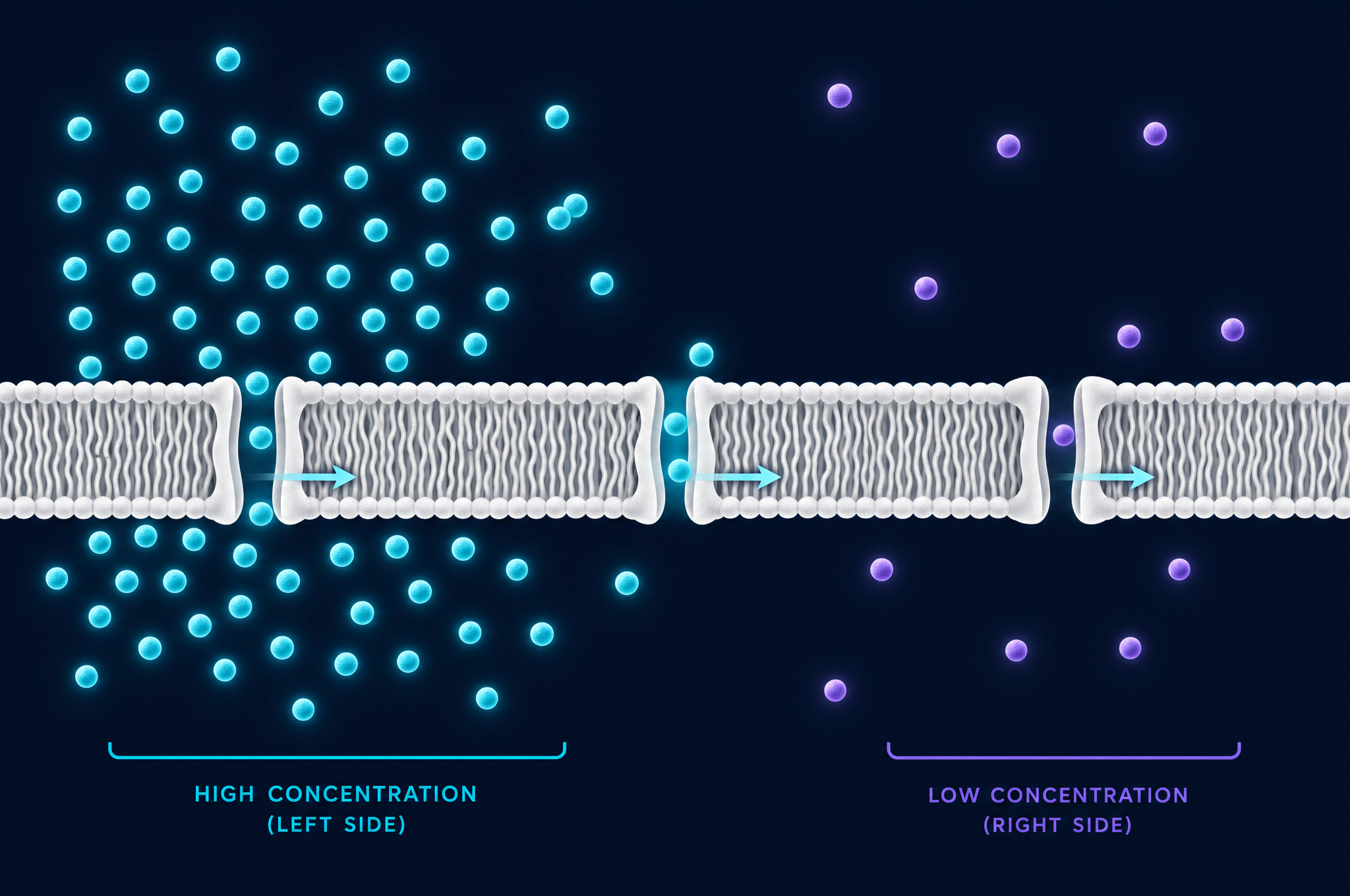
Let's start with the general case. Diffusion is the movement of particles from a region of higher concentration to a region of lower concentration. It requires no energy input — it is passive, driven entirely by the thermal motion of molecules. Drop ink into a glass of water and the pigment spreads until the concentration is uniform everywhere. That is diffusion.
The key point is that diffusion applies to any particle that is free to move: ink molecules, oxygen, carbon dioxide, perfume, ions. Any substance dissolved in a fluid will diffuse down its concentration gradient until equilibrium is reached. This is Fick's first law in action, and it governs everything from how oxygen reaches your cells to how a smell crosses a room.
What Osmosis Actually Is
Osmosis is diffusion — but with a constraint. In osmosis, a semipermeable membrane separates two solutions. The membrane allows the solvent (usually water) to pass through but blocks the solute (the dissolved substance). Water diffuses from the side where it is more concentrated (less solute) to the side where it is less concentrated (more solute).
Osmosis is the diffusion of a solvent across a semipermeable membrane. The membrane is what makes it osmosis rather than ordinary diffusion. Without the membrane, the solute itself would simply diffuse and equalize. The membrane prevents that, forcing the solvent to do the work of equalizing concentration instead.
This is the heart of the distinction. In ordinary diffusion, both solute and solvent move freely. In osmosis, only the solvent can cross the barrier. The solute is trapped, so the system cannot reach equilibrium by moving the solute. Instead, water moves to dilute the more concentrated side until either the concentrations equalize or the pressure difference balances the osmotic pull.
The Raisin Revisited
Return to the raisin. A raisin is a dehydrated grape — its interior is packed with sugars and other solutes, with very little water. The skin of the raisin acts as a semipermeable membrane: water can pass through it, but the large sugar molecules cannot. When you place the raisin in a cup of pure water, there is a high concentration of water outside and a low concentration of water inside (because the sugar takes up space).
Water diffuses across the skin — moving down its own concentration gradient — from the cup into the raisin. The raisin swells. This is osmosis: the diffusion of water across a semipermeable membrane. The process stops when the turgor pressure inside the raisin pushes back hard enough to counteract the osmotic pull, or when the internal concentration has been diluted enough to match the external water concentration.
Why the Distinction Matters in Biology
In a textbook, the difference between osmosis and diffusion is a line on a page. In a living cell, it is the difference between life and death. Cell membranes are semipermeable by design. They allow water to pass relatively freely through channels called aquaporins, but they carefully control the movement of ions, proteins, and other solutes. This selective permeability is what allows cells to maintain concentration gradients — higher potassium inside, higher sodium outside — that are essential for nerve impulses, muscle contraction, and nutrient transport.
Because the membrane blocks most solutes, the cell is subject to osmotic pressure. If the external fluid becomes too dilute (hypotonic), water rushes in and the cell swells. Red blood cells in distilled water will swell until they burst — a process called hemolysis. If the external fluid becomes too concentrated (hypertonic), water rushes out and the cell shrivels. This is why saline drips in hospitals are carefully matched to blood concentration: too much deviation in either direction destroys the cells.
You can read more about how cells manage this delicate balance in our article on cell membrane transport, which covers the active transport mechanisms that work alongside passive diffusion to keep cells alive.
Tonicity: The Practical Consequence
The terms hypotonic, isotonic, and hypertonic describe the relationship between a cell and its environment. But there is a subtlety: tonicity depends on what the membrane allows through, not just on the overall concentration. A solution can be hyperosmotic (higher total solute concentration) but isotonic (no net water movement) if the extra solute can freely cross the membrane. Urea, for example, is hyperosmotic but not hypertonic to most cells, because it crosses their membranes readily. It raises the total solute concentration without creating an osmotic gradient.
This distinction trips up even advanced students. Osmolarity counts all solute particles. Tonicity counts only the particles the membrane blocks. Two solutions with the same osmolarity can have different tonicities if they contain different proportions of permeable versus impermeable solutes.
Everyday Examples
The osmosis-diffusion distinction shows up constantly in daily life, though we rarely label it:
- Salted vegetables: Sprinkling salt on cucumber slices draws out water. The salt creates a hypertonic environment; water leaves the plant cells by osmosis.
- Wilted lettuce in water: Soaking wilted lettuce in cold water revitalizes it because water moves into the cells by osmosis, restoring turgor pressure.
- Preserving food: Sugar in jam and salt in cured meats create hypertonic conditions that kill bacteria by osmotic dehydration.
- Brining meat: Salt diffuses into the meat (ordinary diffusion through tissue), while water moves out (osmosis). The combined effect seasons and tenderizes.
The Common Misconception
The most common error is treating osmosis as if it were a separate process from diffusion — a third type of transport alongside diffusion and active transport. This framing leads students to think osmosis requires some special "water-pulling" force that diffusion doesn't. It doesn't. Osmosis is diffusion. Water moves for the same reason ink spreads: random thermal motion produces net flow from high concentration to low. The membrane simply constrains which molecules can participate in that flow.
The other common error is thinking osmosis always involves water. Strictly speaking, osmosis can occur with any solvent. Water is just the solvent in biological systems, so the biological definition assumes it. In chemistry, osmosis through a membrane with a non-aqueous solvent is perfectly valid.
One Process, Two Contexts
The cleanest way to think about it: diffusion is the general process. Osmosis is the specific case where a semipermeable membrane prevents the solute from diffusing, so the solvent must do the diffusing instead. The raisin swells not because osmosis is different from diffusion, but because the skin blocks the sugar and forces the water to carry the burden of equalization.
If this article helped clarify the relationship, you might also enjoy our explainers on Fick's laws of diffusion, which provide the mathematical framework for all of this, and diffusion in everyday life, which catalogs the many places you encounter these processes without noticing.