You are reading this sentence, and right now, trillions of molecules are diffusing through the air around you. Oxygen is drifting from your lungs into your bloodstream. Carbon dioxide is moving the other way. The scent of whatever you last ate is still spreading, molecule by molecule, from the kitchen to wherever you're sitting. Diffusion is not an abstract concept confined to textbooks. It is one of the most visible, constant physical processes in your daily life.
Once you start looking for it, diffusion is everywhere. The morning tea steeping in your cup. The perfume someone wore on the elevator. The salt melting ice on the driveway. The steak browning in a hot pan. Each of these mundane events is governed by the same simple principle: particles move from where they are concentrated to where they are not, driven by nothing more than the thermal jiggling of molecules. No motors, no pumps, no energy input required. Just randomness, quietly producing order.
The Cup of Tea
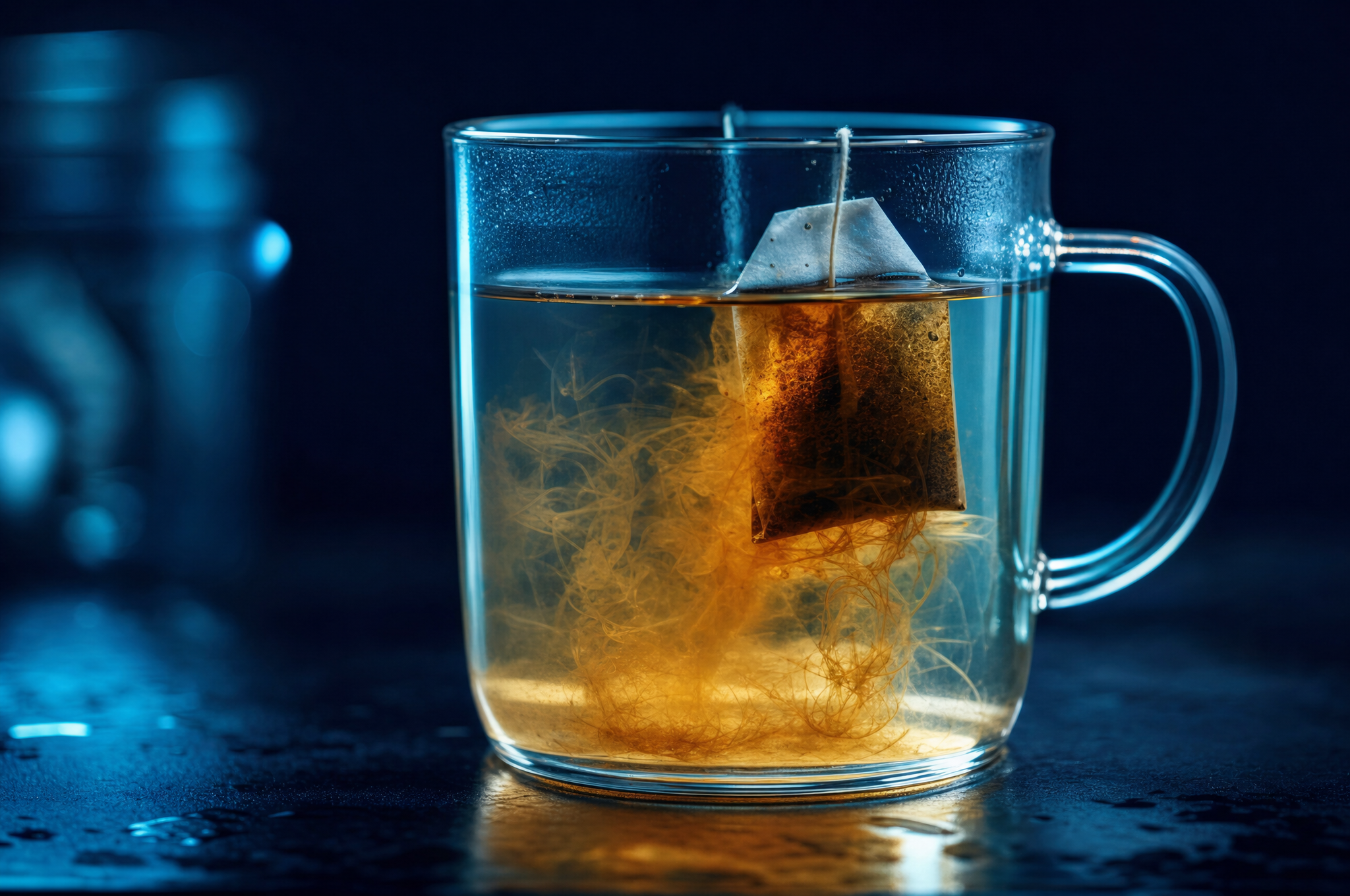
Let's start with the most classic example. You drop a tea bag into hot water. Within seconds, a brown cloud begins to spread from the bag, swirling and growing until the entire cup is a uniform amber color. That cloud is diffusion in action.
Inside the tea bag, the concentration of tea compounds — polyphenols, tannins, caffeine — is enormous. Outside, it is zero. Molecules of these compounds, released from the tea leaves, move randomly in all directions. But because there are far more of them inside the bag than outside, the random motion produces a net flow outward. Over time, the concentration equalizes: every molecule still moves randomly, but there is no longer a net direction because the concentrations are the same everywhere.
Temperature matters enormously. Hot water diffuses tea faster because thermal energy makes molecules move faster — the diffusion coefficient is proportional to temperature. This is why cold-brewing tea takes hours while hot steeping takes minutes. The same molecules, the same process, just slower at lower temperatures.
Drop a single drop of food coloring into a glass of cold water and a glass of hot water simultaneously. The hot-water glass will reach uniform color noticeably faster. You're watching the temperature dependence of diffusion with your own eyes.
Perfume Across a Room
Someone sprays perfume in one corner of a room, and seconds later you smell it from across the room. How? The perfume molecules, volatile enough to evaporate into the air, diffuse outward from the high concentration at the spray site. But pure diffusion in air is actually quite slow — it would take hours for perfume to cross a room by diffusion alone. What you're really experiencing is a combination of diffusion and convection: air currents in the room carry the molecules much faster than diffusion alone could.
In a perfectly still room (no air currents, no temperature gradients), the perfume would eventually reach you, but it would take a very long time. This is why diffusion is dominant in liquids and solids, where convection is minimal, but in gases, it usually works alongside bulk air movement. The same is true for smells outdoors: the wind does most of the transport, with diffusion smoothing out the edges of the scent plume.
Salt on Ice
In winter, we spread salt on icy roads. The salt doesn't melt the ice by generating heat — it works through a diffusion-related process. When salt dissolves into the thin layer of liquid water on the surface of ice, it lowers the freezing point of that water. The salt ions diffuse into the water film, disrupting the equilibrium between ice and liquid. Ice melts to replenish the liquid, the salt diffuses into the new liquid, and the process continues until the temperature drops low enough that even saltwater freezes (around -21°C for sodium chloride).
The key step is the diffusion of salt ions into the water layer. Without diffusion spreading the ions, the salt would just sit on the surface and do nothing. It's the spreading — the movement from high concentration (the salt crystal) to low concentration (the water film) — that makes de-icing work.
Cooking and Marinating
Cooking is applied diffusion science. When you salt a steak an hour before cooking, the salt doesn't stay on the surface. It diffuses into the meat, drawing moisture with it (a combination of osmosis and diffusion) and eventually distributing throughout the muscle fibers. This is why dry brining works: given enough time, salt reaches the interior, seasoning the meat all the way through rather than just the outside.
Marinating works the same way. The acids, salts, and flavor compounds in a marinade diffuse into the food. But diffusion in solids is slow — far slower than in liquids. This is why marinades only penetrate a few millimeters into meat in a few hours. The idea that a marinade "soaks through" a thick steak overnight is mostly myth; diffusion simply doesn't move molecules that fast through dense tissue. Thin cuts or punctured surfaces marinate faster because the diffusion distance is shorter.
Breathing
Every breath you take relies on diffusion. In the alveoli — the tiny air sacs in your lungs — oxygen is at a higher concentration than in the blood flowing past. Carbon dioxide is at a higher concentration in the blood than in the air. So oxygen diffuses from the air into the blood, and carbon dioxide diffuses the other way. No active pumping is involved. The gradients do all the work.
This is why lung disease is so devastating. The alveolar membrane is extraordinarily thin — about 0.2 micrometers — to minimize the distance molecules must diffuse. Any thickening of that membrane, whether from disease or scarring, slows diffusion and starves the body of oxygen. You can read more about how cells manage similar transport challenges in our article on cell membrane transport.
Brewing Coffee
Coffee extraction is diffusion in a porous medium. Hot water passes through ground coffee, and the soluble compounds — caffeine, oils, acids, sugars — diffuse out of the coffee particles and into the water. The grind size controls the surface area and the diffusion distance: finer grind means more surface area and shorter paths for molecules to travel, so extraction is faster. Too fine, and the diffusion is so fast that bitter compounds extract along with the desirable ones. Too coarse, and the diffusion is too slow to extract enough flavor in the brewing time.
Every barista adjusting grind size is, unknowingly, tuning a diffusion process. The same physics that governs a tea bag governs a $4 flat white.
Why It All Works
What unites all these examples is that diffusion requires no energy input. It is a passive process, driven entirely by the thermal motion of molecules. Every molecule above absolute zero is vibrating, colliding, and moving. When there's a concentration difference, that random motion naturally produces net flow from high to low concentration. It's not that the molecules "want" to spread — they're just bouncing, and the statistics of bouncing produce spreading.
This is the deep insight of Brownian motion: diffusion is not a separate force but the accumulated result of trillions of random molecular collisions. The tea spreads not because the tea molecules are being pushed, but because they're being jiggled, and the jiggle happens to carry them, on average, from where there are many to where there are few.
The Invisible Workhorse
Diffusion is one of those processes that works so reliably and so constantly that we never notice it. It keeps us alive (oxygen reaching our cells), flavors our food (salt penetrating meat, tea coloring water), and even shapes our weather (water vapor diffusing through the atmosphere). The next time you watch a drop of milk spread through coffee, take a moment to appreciate it: you're watching Fick's laws unfold in real time, the same physics that Einstein used to prove atoms exist and that now powers the AI generating images from noise.