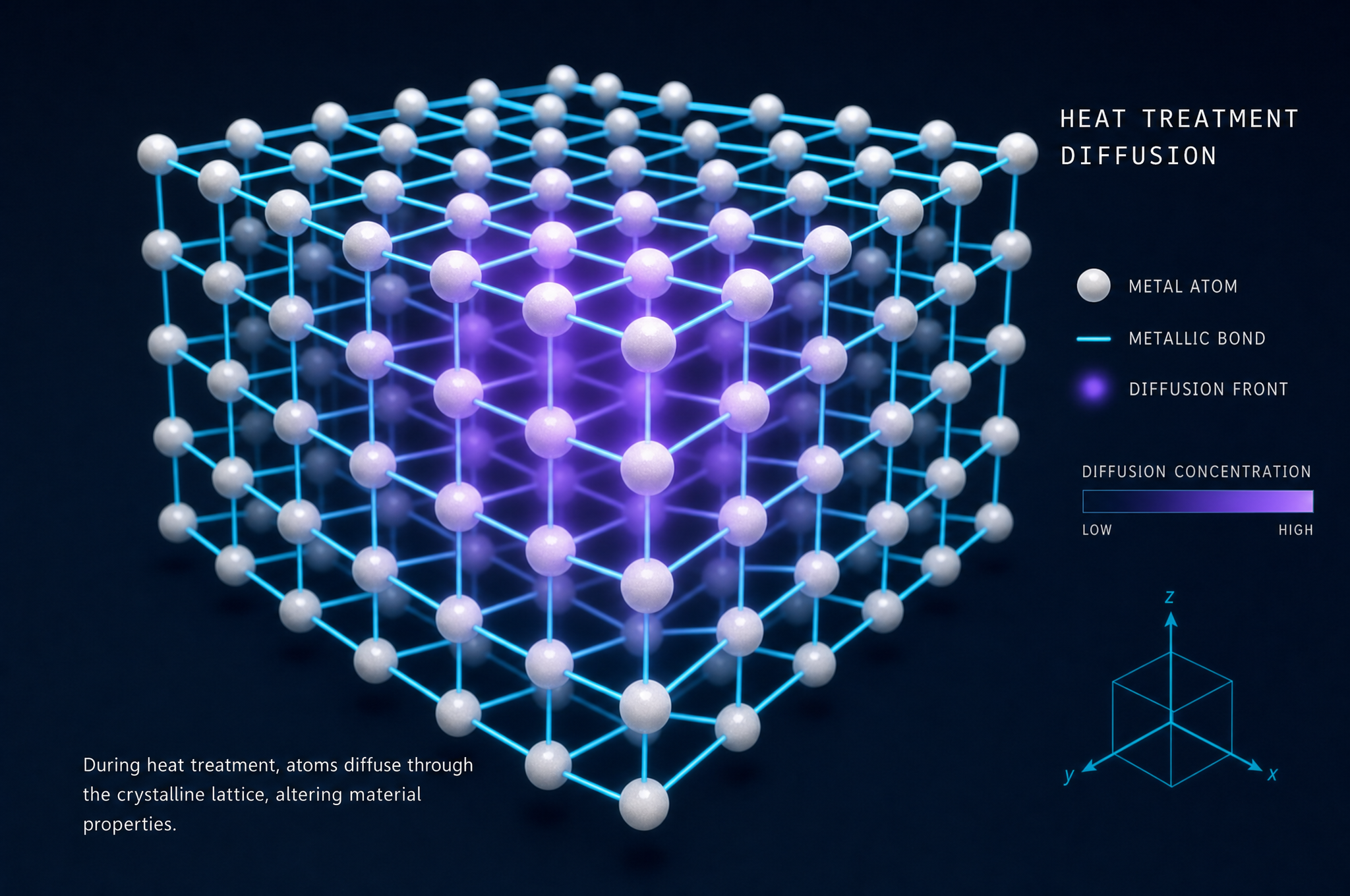
A blacksmith heats a bar of steel until it glows orange, hammers it into shape, then plunges it sizzling into water. The same piece of metal, depending on how it is heated and cooled, can become a soft wire that bends easily or a hard blade that holds a razor edge. The blacksmith's art is at least 3,000 years old. The science behind it — the reason heat treatment transforms metal — is the science of atoms diffusing through a crystal lattice.
Steel is an alloy of iron and carbon, and its properties depend on how the carbon atoms are distributed within the iron crystal. At high temperatures, carbon diffuses rapidly through the iron lattice, redistributing itself. At low temperatures, diffusion slows to a crawl, freezing the carbon in place. The blacksmith's heat-and-quench cycle is a way of first letting carbon move, then trapping it where it landed — and where the carbon ends up determines whether the steel is soft, hard, brittle, or tough.
The Crystal Lattice
Metals are crystalline. Their atoms are arranged in regular, repeating patterns — lattices — that extend throughout the material. Iron, at room temperature, has a body-centered cubic (BCC) structure: each atom sits at the center of a cube with eight neighbors at the corners. Heat iron above 912°C, and it transforms to a face-centered cubic (FCC) structure, which is more densely packed and has different interstitial spaces — the gaps between atoms where smaller atoms like carbon can lodge.
This phase transformation is crucial because carbon's solubility differs between the two structures. FCC iron (called austenite) can dissolve up to about 2% carbon in its interstitial spaces. BCC iron (called ferrite) can hold only about 0.02% carbon. The rest must go somewhere — and where it goes is what makes heat treatment work.
Diffusion in a Solid: How Atoms Move
Diffusion in a solid seems counterintuitive. In a liquid or gas, molecules move freely, and diffusion is easy to visualize. But in a solid crystal, atoms are locked in place. How do they move?
The answer is that they don't move freely — they hop. At any temperature above absolute zero, atoms vibrate around their lattice positions. Occasionally, an atom gains enough thermal energy to jump from its site to a neighboring vacant site (a vacancy). This is vacancy diffusion, and it is the primary mechanism by which atoms move through a crystal lattice. The rate of hopping is exponentially dependent on temperature, following the Arrhenius equation:
The diffusion coefficient in a solid follows D = D₀ exp(-Q / RT), where Q is the activation energy (the energy barrier an atom must overcome to jump), R is the gas constant, and T is absolute temperature. This exponential dependence means diffusion is extraordinarily temperature-sensitive. A modest temperature increase can speed diffusion by orders of magnitude.
This exponential temperature dependence is the key to heat treatment. At room temperature, carbon diffusion in iron is so slow that the carbon distribution is effectively frozen — atoms would take years to move meaningful distances. At 900°C, the same diffusion takes seconds. The blacksmith's forge is not just softening the metal mechanically; it is accelerating carbon diffusion by a factor of trillions, allowing the carbon to redistribute through the lattice.
Annealing: Letting Diffusion Do Its Work
Annealing is the simplest heat treatment: heat the metal to a high temperature, hold it there, then cool it slowly. During the hold, diffusion is fast. Carbon atoms redistribute, vacancies migrate, and internal stresses relax. The metal becomes softer, more ductile, and more uniform. Slow cooling allows the carbon to remain in equilibrium as the temperature drops, so the final structure is the stable one for each temperature.
Annealing is the blacksmith's way of resetting the metal. If a piece has been work-hardened (made brittle by hammering), annealing lets the atoms rearrange themselves into a lower-energy configuration, undoing the damage. It is pure diffusion: the thermal motion of atoms, given enough time at high temperature, finding the most stable arrangement.
Quenching: Freezing Diffusion Mid-Step
Quenching is the opposite strategy. Heat the steel to the austenite phase (above 912°C, where carbon dissolves freely in the FCC lattice), then cool it rapidly — by plunging it into water or oil. The rapid cooling doesn't give carbon time to diffuse out of the lattice as the iron transforms back to BCC. The carbon is trapped where it was in the high-temperature structure, even though the BCC lattice can't accommodate it.
The result is a metastable, highly stressed structure called martensite. The iron lattice is distorted by the excess carbon, stretched into a tetragonal shape that is extremely hard but also brittle. Martensite is not an equilibrium phase — it exists only because diffusion was too slow to allow the system to reach equilibrium. The blacksmith has essentially frozen the metal in a high-energy state by cutting off the diffusion that would let it relax.
This is the deep connection between heat treatment and diffusion: quenching works by exploiting the temperature dependence of the diffusion coefficient. The Arrhenius equation says diffusion is fast at high temperature and slow at low temperature. Quenching moves the metal from high to low temperature so fast that the carbon doesn't have time to diffuse — the process that would normally occur over minutes at 900°C would take millennia at room temperature.
Tempering: Controlled Re-Diffusion
Quenched martensite is too brittle for most uses — a quenched blade would shatter rather than bend. Tempering solves this by reheating the quenched steel to a moderate temperature (150-650°C, well below the austenite transition) for a controlled time. At these temperatures, carbon diffusion is slow but not zero. Some of the excess carbon precipitates out of the distorted martensite lattice, forming tiny carbide particles. The lattice relaxes slightly, reducing brittleness while retaining most of the hardness.
Tempering is a careful negotiation with diffusion. Too little time at temperature, and the steel remains brittle. Too much, and too much carbon diffuses out, and the steel becomes soft. The blacksmith's skill is in choosing the temperature and duration to hit the exact balance of hardness and toughness for the intended application — a balance that is fundamentally a balance of how far carbon is allowed to diffuse.
Beyond Steel: Diffusion Everywhere in Materials
Steel is the classic example, but diffusion controls the processing of virtually every engineering material:
- Semiconductor doping: The transistors in every computer chip are made by diffusing impurity atoms (boron, phosphorus) into silicon wafers at high temperature. The depth and concentration of the dopant — controlled by time, temperature, and Fick's laws — determine the electrical properties of each transistor.
- Aluminum alloys: Aerospace aluminum is strengthened by precipitation hardening — a process conceptually identical to tempering, where controlled diffusion forms tiny precipitates that impede dislocation motion.
- Ceramics: Sintering — the process that turns powder into solid ceramic — works by diffusion. At high temperature, atoms diffuse from particle surfaces to the necks between particles, gradually fusing them into a dense solid.
- Glass: Chemical strengthening of smartphone glass (like Gorilla Glass) works by diffusing large potassium ions into the surface, replacing smaller sodium ions and creating compressive stress that resists cracking.
The Arrhenius Law in Practice
The exponential temperature dependence of solid-state diffusion has practical consequences that engineers must navigate. A heat treatment that works perfectly at 850°C might produce completely different results at 800°C — not because the temperature is slightly lower, but because the diffusion rate has dropped by a factor of two or three. This is why industrial furnaces must maintain precise temperature control: a 10-degree error can change the diffusion rate enough to ruin the treatment.
It also means that diffusion-limited processes have a time-temperature equivalence. You can often achieve the same result by holding at a lower temperature for a longer time, or a higher temperature for a shorter time — as long as the integral of the diffusion rate over time is the same. This is why heat treatment recipes specify both temperature and duration, and why processes can be accelerated by raising temperature (at the risk of overshooting or causing unwanted phase transformations).
The Mathematics: Fick's Laws in Solids
The diffusion of atoms in a crystal lattice follows the same Fick's laws that govern diffusion in liquids and gases — the mathematics is universal. Fick's first law gives the flux (atoms crossing a plane per unit area per unit time), and the second law gives how concentration evolves. The only difference is that the diffusion coefficient D is much smaller in solids, and it follows the Arrhenius temperature dependence rather than the simple linear dependence seen in fluids.
For carburizing — the process of diffusing carbon into the surface of steel to harden it — engineers use the solution to Fick's second law for a semi-infinite solid with a constant surface concentration. The depth of the hardened layer grows as the square root of time, the same √t scaling that appears in Brownian motion and in every other diffusive process. The universality of this scaling is one of the deep connections that unify diffusion across all of science.
An Ancient Art, Explained
The blacksmith working at a forge 3,000 years ago had no knowledge of atoms, crystal lattices, or the Arrhenius equation. But through centuries of trial and error, smiths discovered that heating and cooling metal in specific ways could dramatically change its properties. They were, unknowingly, controlling the diffusion of carbon through iron — accelerating it with heat, freezing it with quenching, and partially reversing it with tempering.
Modern materials science has placed this ancient art on a rigorous mathematical foundation, but the core insight hasn't changed: the properties of a material depend on the arrangement of its atoms, and the arrangement of atoms is controlled by diffusion. Whether you're hardening a sword, doping a silicon chip, or sintering a ceramic, you are managing diffusion — deciding when to let atoms move and when to trap them in place. It is the same physics that Fick described, playing out in the rigid world of crystals rather than the fluid world of liquids.